
WELCOME BONUS 300%
UP TO €2000 + 100
FREE SPINS
UP TO €2000 + 100
FREE SPINS
Home → Blackjack
Blackjack at Excitewin: Variants, Rules and Payouts
Check table limit before the first bet
The Infinite Blackjack table at Evolution allows wagers ranging from 1 EUR to 5,000 EUR per hand. This upper limit permits high-stakes players to place maximum bets without exceeding the casino's risk threshold for a single round. The wide range ensures that both casual and professional gamblers can find a suitable entry point for their bankroll management strategy.
Quantum Blackjack Plus Live by Playtech also supports stakes between 1 EUR and 5,000 EUR for every single deal. This identical cap means that budget planning remains consistent across different software providers when selecting a live dealer game. Players must verify these limits before depositing funds to ensure their intended wager size is actually permitted on the specific table selected.
Splitting costs double bet: plan budget
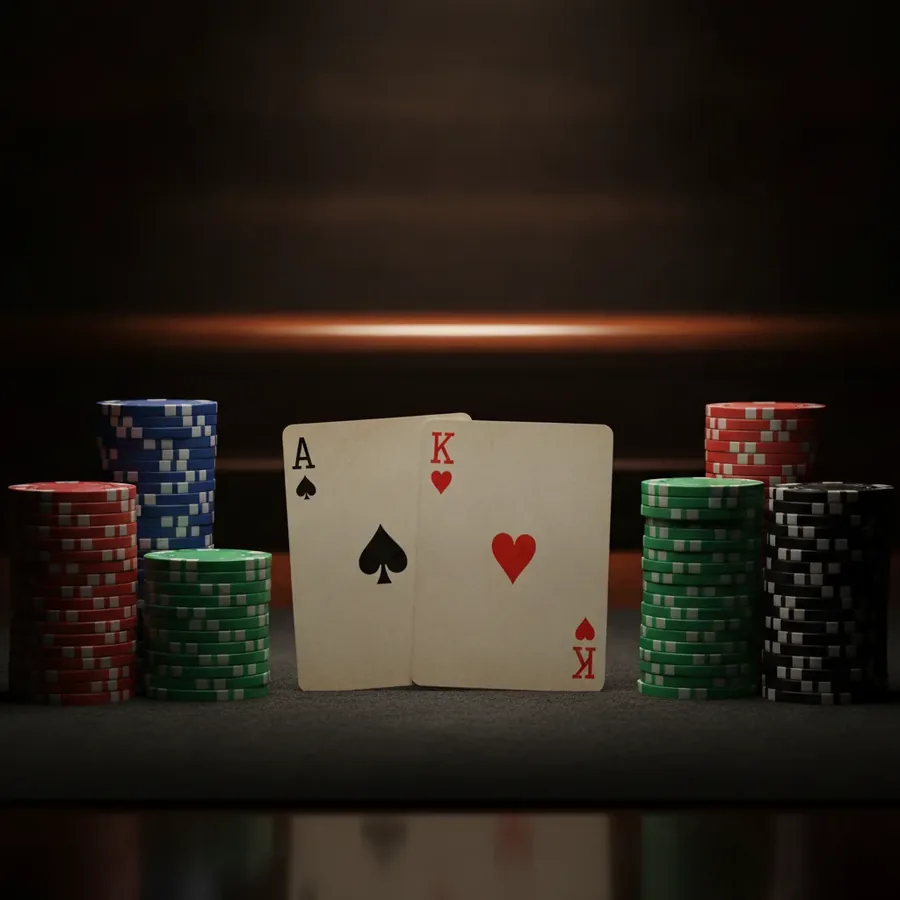
Blackjack rules permit splitting pairs into up to four separate hands, which instantly doubles or triples the initial stake required for each new hand. When a player splits a pair of tens, they must post two additional bets equal to the original wager to continue playing both hands independently. This mechanic significantly increases the total amount of money exposed to the house edge during a single round of play.
How many decks are in the shoe?
The standard Blackjack Surrender variant typically utilizes eight decks of cards shuffled together to prevent card counting and maintain game integrity. Using more decks generally increases the house advantage because it reduces the probability of drawing natural blackjacks compared to single-deck games. Players should expect a lower return-to-player percentage when the game uses six or eight decks instead of just one deck.
Split, Double Down, and Surrender in Numbers
Late Surrender improves the Return to Player rate by approximately 0.08 percent by allowing players to forfeit half their bet after the dealer checks for blackjack. Resplitting Aces provides an additional benefit of 0.08 percent, while allowing Double After Split adds roughly 0.14 percent to the player's theoretical return. These specific rule modifiers collectively reduce the house edge significantly compared to tables that prohibit these advantageous actions entirely.
Error insurance: 7 percent additional house edge
Purchasing Insurance on Infinite Blackjack or Lightning Blackjack carries a massive house edge of 7.47 percent for six to eight deck games. This side bet pays 2:1 but is statistically unfavorable unless the player is actively counting cards with a true count of plus three or higher. Taking this wager unnecessarily erodes long-term profits and contradicts basic strategy recommendations for optimal play in standard blackjack scenarios.
Blackjack variants at a glance
| Variant | Payout | House edge | Rule | Bet range |
|---|---|---|---|---|
| Blackjack Insurance / Versicherung (6–8 Decks) | 92.53% | 7.47% | Separate Nebenwette bis 50% der Hauptwette, wenn der Dealer ein Ass hat. Basisstrategie schreibt IMMER Ablehnung vor (außer Karten zählen bei True Count ≥ +3). Bei einem Deck Vorteil ≈ 5.88% | Insurance 2:1 |
| Blackjack Split / Double / H17 – Regel-Effekte | n.a. (Regel-Modifikatoren) | H17 +0.22 Prozentpunkte; RSA −0.08 Prozentpunkte; DAS −0.14 Prozentpunkte | Dealer Hits Soft 17 verschlechtert RTP um 0.22 Prozentpunkte; Resplit Aces verbessert um 0.08 Prozentpunkte; Double After Split verbessert um ca. 0.14 Prozentpunkte; 6 Decks statt 8 – ca. 0.02 Prozentpunkte. | Double – Einsatz ×2 mit einer Karte; Split – bis 4 Hände; Ass-Split meist mit einer Karte. |
| Blackjack 6 Decks, S17, DAS, DOA, Auszahlung 3:2, Basisstrategie | 99.54% | 0.46% | Dealer steht auf Soft 17; Verdopplung auf jeder Zweierkarte; Verdopplung nach Split erlaubt; keine Aufgabe. Basisstrategie ist für diesen Wert zwingend | Blackjack 3:2, normaler Gewinn 1:1, Insurance 2:1 |
| Blackjack Liberal Vegas Strip (liberale Regeln, 3:2) | 99.72% | 0.28% | Günstigste Regelkombination: S17 + DAS + Resplit + Late Surrender. Standardabweichung 1,15 | Blackjack 3:2, Gewinn 1:1 |
| Blackjack Auszahlung 6:5 statt 3:2 (6 Decks) | 98.15% | 1.85% | Ersatz von 3:2 durch 6:5 fügt exakt +1.39 Prozentpunkte zum Vorteil des Casinos hinzu – stärker als jede andere Regeländerung. Bei $10 Einsatz zahlt Blackjack $12 statt $15. | Blackjack 6:5, Gewinn 1:1 |
| Blackjack Ein Deck, klassische Regeln, 3:2 | 99.85% | 0.15% | Weniger Decks = niedrigerer Vorteil; ein Deck gibt ca. −0.48 Prozentpunkte gegenüber 8 Decks. Oft durch 6:5 Auszahlung kompensiert. | Blackjack 3:2, Gewinn 1:1 |
Which table limits suit 20 EUR balance?
The Infinite Blackjack live table by Evolution permits entry stakes starting at 1 EUR, allowing a 20 EUR bankroll to survive numerous rounds without immediate depletion. This minimum limit contrasts with the upper cap of 5,000 EUR, providing ample room for standard progression systems or conservative flat betting strategies over an extended session. Players must verify that their deposit method supports small transactions to avoid unnecessary withdrawal fees when managing tight budgets. The wide range ensures that low rollers can participate in high-stakes environments without risking their entire balance on a single hand.
Quantum Blackjack Plus Live also sets its floor at 1 EUR, enabling players to test the quantum multiplier mechanics while preserving capital for potential 1,000x payouts on winning twenty-one combinations. The maximum stake of 5,000 EUR remains irrelevant for those with limited funds, as the primary focus shifts to hitting specific card combinations rather than wagering large sums. This structure allows for calculated risk-taking where small bets accumulate into significant returns through the game's unique multiplier features. Understanding these limits helps maintain discipline and prevents impulsive decisions that could deplete a modest account quickly.
Lightning Blackjack offers a slightly different ceiling with a maximum bet of 2,500 EUR, though its 1 EUR minimum still accommodates small balances effectively. The lightning multipliers up to 25x apply only to winning hands, meaning a 20 EUR balance can grow substantially if luck aligns with the random number generator. Careful monitoring of the bankroll against these variable outcomes ensures longevity and maximizes the utility of every euro placed on the felt.
What Hole Card Means at a Live Table
In digital blackjack variants like Infinite Blackjack from Evolution, the hole card is the dealer's second card dealt face-down after the initial two cards are exposed to all participants. This concealed value determines whether the dealer has achieved a natural twenty-one or bust immediately, triggering specific payout conditions before any player actions occur. The presence of this hidden card necessitates strict adherence to basic strategy charts, as guessing incorrectly leads to predictable long-term losses due to the house edge. Players cannot see this card until the dealer reveals it following all player decisions, creating a critical information asymmetry inherent to the game.
The Quantum Blackjack Plus Live variant maintains this standard protocol where the hole card dictates the flow of the round, potentially activating quantum multipliers if the final hand totals exactly twenty-one points. Since the dealer checks for blackjack before players act, knowing the hole card's status is impossible until the reveal phase concludes. This mechanism protects the casino's integrity while ensuring fair play across unlimited seats, as every participant receives identical information simultaneously. The RTP of 99.57 percent assumes optimal strategy usage, which includes making mathematically correct decisions despite lacking knowledge of this specific card.
Lightning Blackjack introduces an additional layer of complexity where the hole card interacts with lightning multipliers applied to winning hands during the settlement phase. If the dealer holds a strong hand revealed by the hole card, players may lose their base wagers regardless of any side bet successes. The maximum multiplier of 25x applies to the winning combination, but only after the hole card confirms no dealer blackjack exists. Consequently, understanding the role of the hole card is essential for managing expectations regarding potential payouts and recognizing when a loss is inevitable based on the dealer's hidden value.
16 vs 10 played incorrectly: most common error
A hard sixteen against a dealer ten represents one of the most statistically unfavorable situations in blackjack, often leading players to make the erroneous decision to hit instead of surrendering or standing. In games offering Late Surrender, such as the Liberal Vegas Strip variant, giving up half the stake reduces the expected loss compared to playing out the hand where bust probability exceeds fifty percent. The house edge increases significantly when players ignore this rule, turning a manageable loss into a guaranteed depletion of their bankroll over time. Correct strategy dictates minimizing damage rather than chasing unlikely wins against a strong dealer up-card.
When evaluating the impact of rules like Stand on Soft 17 (S17) versus Hit on Soft 17 (H17), the latter worsens the overall house edge by 0.22 percentage points, indirectly affecting how players should handle marginal hands like sixteen versus ten. In a standard six-deck shoe with S17 and Double After Split allowed, the base house advantage sits at 0.46 percent, requiring precise execution to maintain profitability. Deviating from basic strategy by hitting sixteen against a ten increases the variance and accelerates the erosion of funds, making disciplined play crucial for survival. Players must recognize that statistical edges compound over thousands of hands, punishing occasional lapses in judgment severely.
The introduction of side bets like Any Pair or 21+3 in live dealer games distracts players from fundamental strategy, encouraging risky behavior when facing difficult decisions like sixteen versus ten. While these bets offer attractive payouts, they carry much higher house edges, such as the 7.47 percent disadvantage found in insurance wagers, further penalizing poor decision-making. Ignoring the core objective of minimizing losses against a ten-up card leads to faster bankruptcy, especially when combined with the temptation to chase big wins through secondary mechanisms. Adherence to proven mathematical strategies remains the only viable path to extending playtime and protecting the principal investment.
RNG draws cards from virtual eight-deck shoe
Random Number Generator algorithms simulate an eight-deck shoe by continuously shuffling virtual cards to ensure each hand is independent and unpredictable, mimicking the physical reality of multiple decks. This setup typically results in a higher house edge compared to single-deck games, as seen in the comparison where eight decks increase the advantage by approximately 0.48 percentage points relative to one deck. The continuous shuffle eliminates card counting effectiveness, forcing players to rely solely on basic strategy charts to navigate the statistical landscape presented by the software. Such mechanics are standard in RNG-based titles to maintain fairness and prevent systematic exploitation by skilled participants.
The RTP of 99.85 percent associated with single-deck blackjack highlights the penalty imposed by using eight decks, where the reduced favorable conditions lower the return to player percentage. In contrast, a six-deck game with liberal rules like DAS and Resplit Aces achieves a superior 99.54 percent RTP, demonstrating how rule variations outweigh the impact of deck count alone. Players engaging with RNG versions must understand that the virtual shoe does not change composition between hands, unlike physical shoes that become more favorable as low cards are removed. This static nature requires consistent application of strategy to mitigate the inherent mathematical disadvantage built into the game parameters.
Side bets in RNG environments, such as those found in live dealer streams, often operate on separate probability pools that do not benefit from the main game's favorable rules. For instance, insurance bets carry a steep 7.47 percent house edge, making them highly unprofitable unless the player employs advanced techniques like true count tracking, which is impossible in RNG settings. The inability to track cards means players must accept the full brunt of the house advantage on both primary and secondary wagers. Recognizing these limitations helps manage expectations and encourages focusing on the main game where strategic decisions yield better long-term results.
Bust at 22: Stake Lost Immediately
Reaching a total of twenty-two or higher constitutes an automatic bust in blackjack, resulting in the immediate forfeiture of the entire stake regardless of the dealer's final hand value. This rule applies uniformly across all variants, including Infinite Blackjack and Quantum Blackjack Plus Live, where any hand exceeding twenty-one points triggers a loss condition before settlement occurs. The severity of this outcome emphasizes the importance of avoiding hits on marginal totals like twelve through seventeen when the dealer shows a strong up-card. Players must calculate probabilities carefully to minimize the frequency of busts, which represent the most common cause of bankroll depletion in the short term.
The impact of busting is exacerbated in games with high volatility, where large swings in balance occur frequently due to the binary nature of winning or losing each hand. In Quantum Blackjack Plus Live, while multipliers can amplify wins, they cannot save a busted hand, meaning a twenty-two results in zero return even if other factors might have favored the player. The maximum multiplier of 1,000x applies only to successful twenty-one combinations, highlighting the exclusivity of rewards for optimal play. Understanding this constraint reinforces the need for disciplined decision-making to avoid self-inflicted losses that negate any potential gains from lucky streaks.
Insurance bets, which pay 2:1 if the dealer has blackjack, do not protect against busts caused by the player's own poor drawing decisions. These side wagers introduce additional complexity and cost, often leading to net losses when combined with frequent busts from aggressive hitting strategies. The 7.47 percent house edge on insurance makes it a poor choice for most players, especially those already struggling with bankroll management. Focusing on reducing bust frequency through basic strategy adherence provides a more reliable path to sustaining play and achieving positive outcomes over time.
Soft 17: Dealer Hits or Stands
The rule where the dealer hits soft 17 adds 0.22 percentage points to the house edge compared to standing rules, which significantly reduces player returns over time. This mathematical penalty applies to standard games using six decks and basic strategy adherence without additional liberal modifiers. Players must adjust their decision matrix to account for this increased risk when calculating long-term expected value.
Resplitting aces improves the RTP by 0.08 percentage points, partially offsetting the negative impact of hitting soft 17 on the overall game profitability. The double after split feature provides an additional 0.14 percentage point improvement, creating a more favorable environment for strategic players. These combined rule changes demonstrate how specific mechanical variations directly influence the final house advantage calculation.
The difference between eight decks and six decks results in only a 0.02 percentage point change, making deck count less critical than dealer behavior. Soft 17 rules remain a primary determinant of game quality alongside surrender options and doubling restrictions. Understanding these precise numerical impacts allows players to select tables that minimize the statistical disadvantage inherent in casino gaming.
Set session stop after 30 percent loss
Blackjack Insurance carries a 7.47% house edge when separate side bets are placed if the dealer shows an ace, drastically reducing overall session bankroll longevity. The base strategy dictates always declining this insurance unless card counting yields a true count greater than or equal to +3 for accurate tracking. Accepting this unfavorable wager accelerates capital depletion beyond standard table game variance limits during typical play sessions.
Standard blackjack payouts return 150 EUR on a 100 EUR bet under 3:2 rules, whereas 6:5 variants pay only 120 EUR, increasing the house edge to 1.85%. This structural difference transforms a low-edge game into one with nearly four times the average cost per hand played. Players monitoring a 30% loss threshold must recognize that unfavorable payout structures erode funds much faster than statistical averages suggest.
Infinite Blackjack from Evolution offers unlimited seats with wagers ranging from 1 to 5,000 EUR, allowing flexible bankroll management strategies. Quantum Blackjack Plus introduces multipliers up to 1,000x on three-card combinations, adding volatility that complicates simple loss-limit calculations. Lightning Blackjack provides multipliers up to 25x but caps bets at 2,500 EUR, requiring adjusted stake sizing for consistent progression control.
Insurance vs Even Money on Own Blackjack
Insurance bets pay 2:1 odds but carry a severe 7.47% house edge, making them statistically inferior to holding the original wager in most scenarios. The baseline strategy explicitly forbids taking insurance except when card counting indicates a true count of plus three or higher for positive expectation. This rigid rule protects players from the substantial long-term erosion caused by accepting negative expectation side wagers repeatedly.
Even money acts as a guaranteed 1:1 payout when the dealer likely holds blackjack, effectively converting a potential 3:2 win into a certain smaller gain. This option is mathematically equivalent to taking insurance on a natural blackjack hand, preserving principal but sacrificing the superior 3:2 reward probability. Analyzing this choice requires comparing the immediate certainty of even money against the higher expected value of letting the hand ride.
Liberal Vegas Strip rules featuring soft 17 stands and late surrender achieve a minimal 0.28% house edge, maximizing the value of natural blackjacks. The standard deviation of 1.15 indicates moderate volatility, meaning outcomes cluster closer to the mean than high-variance slot machines do. Players prioritizing bankroll preservation should avoid insurance to maintain alignment with the optimal theoretical return provided by these favorable rule sets.
What doesn't count as Blackjack after Split?
Splits allow players to divide pairs into two separate hands, typically limited to four total hands, with aces usually restricted to receiving only one additional card. This limitation prevents the creation of multiple strong hands from a single pair, thereby capping the potential upside of aggressive splitting strategies. Understanding these constraints helps players manage expectations regarding hand strength and subsequent betting opportunities during extended playing sessions.
Double After Split (DAS) permits doubling down on any two cards after a split, improving the RTP by approximately 0.14 percentage points compared to restrictive rules. This mechanic enhances strategic flexibility but does not alter the fundamental definition of a natural blackjack, which requires exactly two cards totaling twenty-one initially. Players must distinguish between enhanced playing options and the strict criteria required for achieving the highest paying blackjack outcome.
Late Surrender allows players to forfeit half their bet after the dealer checks for blackjack, improving RTP by 0.08 percentage points through reduced losses. Early surrender, worth up to 0.6 percentage points, is extremely rare and generally unavailable in modern online environments. Recognizing these specific exclusions ensures players accurately calculate their actual exposure and avoid misconceptions about available protective measures during gameplay.
How long do 100 EUR last at a 1 EUR table?
Playing at a minimum 1 EUR stake with a 100 EUR bankroll provides 100 initial units of betting power before any wins or losses occur. Assuming a standard house edge of roughly 0.46% for six-deck games with favorable rules, the expected loss per hour depends heavily on hands dealt per minute. This baseline calculation establishes the maximum duration possible under ideal conditions where no variance occurs during the session.
Table games contribute only 10% toward bonus wagering requirements, unlike slots which contribute 100%, significantly extending the turnover needed to clear promotional funds. With a 300% welcome bonus up to 2,000 EUR, players must generate substantially higher turnover on blackjack tables compared to slot machines. This contribution rate drastically reduces the effective value of playing low-stakes blackjack when attempting to meet associated wagering obligations efficiently.
Infinite Blackjack supports bets from 1 to 5,000 EUR, allowing players to scale stakes dynamically based on remaining bankroll size and confidence levels. Quantum Blackjack Plus offers multipliers up to 1,000x, introducing high volatility that can rapidly deplete or inflate a 100 EUR starting balance. Lightning Blackjack caps at 2,500 EUR with 25x multipliers, offering a middle ground between steady play and explosive variance for bankroll management.
Contact
Live - online chat
Banking









Providers












Excitewin Casino 2026